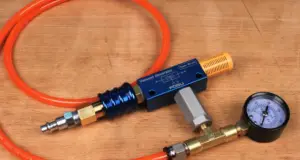
Recovering Freon With Vacuum Pump
How To Recover Freon With Vacuum Pump? Condensation is expected to restore Freon from a system. This part will go over how to achieve it with a vacuum pump in a structured approach. To recover Freon with a vacuum pump, take the following steps
1st Step To Recover Freon With Vacuum Pump
Invest In A Recovery Tank
Locate a refrigerant recovery tank that has 1/4′′ fittings. You could utilize a propane tank if you emptied it. You could try releasing the remaining air into the atmosphere. Disconnect the existing faucets and thoroughly clean the tank. Adapters, a valve, and a 1/4′′ fitting are then screwed in. Freon pressures are often lower than the rated pressure of a propane tank. As long as the tank does not get too hot, there should be no overflowing issues.
2nd Step
Collect The Necessary Attachments
Purchase a high/low/vacuum valve automotive HVAC manifold. Get the hoses and high/low side Freon couplers as well. To begin the main task, get an automobile two-stage vacuum pump.
3rd Step
Join The Attachments Together
Connecting the three hoses is the Next Step for you. Connect the manifold to the low side of the blue hose and coupler. Connect the yellow pipe to the recovery container in the same way. The black vacuum tube is then connected to the pump.
4th Step
Control The Valves
The tank valve, vacuum valve, and LOW valve should all be opened. Disconnect the low Freon coupler after that.
5th Step
System Should Be Evacuated To Recover Freon With Vacuum Pump
The recovery tank and the three hoses must now be evacuated. Close the vacuum valve when you’re finished. The pump and black hose should then be disconnected from the gauge. The tank, manifold, yellow, and blue pipes will be drained in the meanwhile.
6th Step
The Tank Should Be Frozen To Recover Freon With Vacuum Pump
To freeze the tank, locate a chest freezer. Place the tank in the freezer and leave it there overnight. Also, make sure the system you’re operating on has had time to calm down.
7th Step
Begin Emptying The Freon
Shut the low valve and connect the system’s low-side coupler. After that, you’ll need to open the coupler. Then slowly open the low valve until the force does not approach the rated pressure of the refrigerant at room temperature. The Freon will be drain into the tank via the low-side valve. The refrigerant condensing is in the container.
8th Step
Sublimation Should Be Stop To Recover Freon With Vacuum Pump
Finally, put the tank in a plastic bucket filled with ice. Then return it to the freezer. The sublimation will be slow as a result of this. Remember to shut all the valves, including the tank valves. These are the things to remember when removing Freon from the network.
With A Vacuum Pump, How Can You Get Freon Out Of A Car
The procedure of removing Freon from a car air conditioner is identical to that of removing refrigerant from a system. Get a recovery tank and all of the necessary adapters, valves, and fittings first. The HVAC manifold, hoses, and couplers are also included. Connect the hoses for the manifold, vacuum pump, and tank. Remove the tank and hoses from the tank and place them in a chest freezer.
You can also place the container in the freezer to decelerate the sublimation process. That’s how you get the refrigerant out of your car’s air conditioning system.
Is It Possible To Recover R134a Using A Vacuum Pump
With a vacuum pump, you can recover R134a. Condensation is a simple way to recover R134a. At 100°F, the refringent has a pressure of 150psi. To acquire a recovery tank that can withstand pressures of above 300 psi. Just keep an eye on the tank and make sure it doesn’t get too hot. Gather the vacuum pump, manifolds, pipes, and switches.
Attach the hoses to the installations they belong to. Disperse the installations and place the recuperation container in the freezer for the night. To take out R134a, adjust the low-side valve. At room temperature, the pressure of R134a should be no more than 150 psi. Begin to open the low valve to avoid exceeding the limit.
Conclusion
A vacuum pump is a multifunctional tool that may be used for various tasks, such as bleeding a clutch, vacuuming the AC system, and so on. Using a vacuum pump to recover Freon is a difficult process. If you work as a shade tree mechanic, you must be even more conscientious. The steps are precise and must be carry out correctly. If you’re not sure what you’re doing, it’s advisable to get professional assistance.